EN
EN


How to Correctly Create the Entry Point During Surgery for Intertrochanteric Fractures
First, a small incision of approximately 2–3 cm is made just proximal to the greater trochanter to establish a proper soft‑tissue corridor. For elderly patients with poor bone quality, to reduce surgical time, a direct entry technique can be employed using an entry awl followed by immediate nail insertion. While opening the cortex, special attention must be paid: palpate the medial aspect of the greater trochanter tip with your finger, then insert the awl following the direction guided by your finger. The awl must be kept strictly aligned with the long axis of the patient's body.
This, however, places higher demands on patient positioning. Correct positioning provides the surgeon with sufficient operating space and ensures smooth nail insertion.
The awl is inserted with a rotational motion, following the direction of the medullary canal. When applying force, note that the medial cortex is harder, while the lateral cortex is softer. Therefore, the force direction during opening must be aimed medially toward the canal. In most cases, a single attempt will succeed.
Once fluoroscopic localization is confirmed to be accurate, the nail can be inserted. For surgeons with less experience who have not yet achieved a high level of tactile‑guided intuition, it is advisable to use more fluoroscopic views—both anteroposterior and lateral—and to adjust the entry point according to the medullary canal direction until the optimal opening is achieved.
In certain situations—such as when the fracture line runs exactly through the entry zone, or in younger patients with good bone quality where direct awl opening is not feasible—a K‑wire‑guided technique is recommended. First, a guidewire is precisely placed at the correct position, and then, using the wire as a center, sequential reaming is performed to enlarge the entry aperture.
It is particularly important to emphasize that the opening must be sufficiently large. Otherwise, fracture displacement during nail insertion can easily occur. However, due to the limited operating space and the inherent property of the cortex being harder medially and softer laterally, it is common to observe that during reaming the harder medial cortex tends to deflect the reamer toward the softer lateral greater trochanter, resulting in lateralization of the entry point.
Each surgeon has their own tricks to overcome this lateralization:
Some deliberately overcorrect by starting slightly more medially.
Others use auxiliary instruments—such as retractors or periosteal elevators—to apply a medial counterforce against the reamer, minimizing interference from the lateral cortex.
Some use a small plate to protect the lateral wall, ensuring it remains undisturbed.
Another technique involves bending the tip of the guidewire into an upward curve, utilizing the wire's own elasticity to protect the lateral cortex.
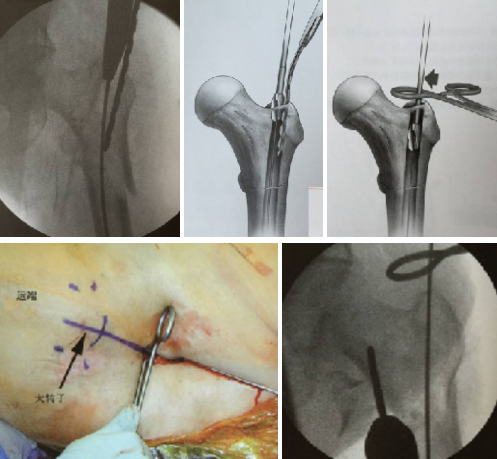
Illustration: Opening and reaming with instrument assistance to avoid damage to the lateral wall.