EN
EN


Subtrokanteriske femurfrakturer: Anatomi, klassifikation og behandlingsmuligheder
Subtrokanteriske (ST) lårknoglefrakturer defineres som frakturer, der opstår inden for 5 cm distalt for den mindre trokanter. Samlet set er den estimerede incidens af disse frakturer cirka 15–20 pr. 100.000 personer pr. år. Aldersfordelingen viser et bimodalt mønster: personer under 40 år udgør ca. 20 % af ST-frakturerne, mens personer over 50 år udgør mere end to tredjedele. Hos yngre personer er forholdet mellem mænd og kvinder næsten ligeligt; men med stigende alder bliver incidensen højere hos kvinder. Yderligere risikofaktorer for ST-frakturer omfatter patienter med osteoporose, der modtager bisfosfonatbehandling, lav total knogledensitet samt kroniske tilstande såsom diabetes mellitus.
- Kirurgi er hovedstøtten i behandlingen af ST-frakturer, hvor intramedullære søm (IM) og ekstramedullære plader er de primære implantater.
- Blandt disse tilbudte intramedullære spænder biologiske og biomekaniske fordele og er blevet guldstandarden for behandling af subtrokanteriske (ST) lårknogleskader.
- Orthopædkirurger bør være fortrolige med og beherske flere reduktionsteknikker for at opnå anatomic alignment ved alle unikke ST-frakturmønstre.
- Denne artikel giver en omfattende gennemgang af epidemiologi, anatomi, biomekanik, klinisk fremtræden, diagnose og behandling af subtrokanteriske lårknogleskader.
Anatomi
For at kunne diagnosticere og behandle ST-frakturer korrekt, skal ortopædkirurger have en grundig forståelse af den relevante anatomi. ST-regionen omfatter metafysisk-diaphysisk overgang i den proksimale femur inden for 5 cm distalt for den mindre trochanter. Calcar femorale er afgørende for opretholdelsen af integriteten i den proksimale femurs knoglestruktur og yder mekanisk støtte til den proksimale femur. Denne tætte knoglestruktur ligger på den posteromediale side af femuren, udgår distalt for den mindre trochanter og løber til sin afslutning ved den posteroinferiore del af femurhalsen. Under stående og gang kan calcar femorale bære belastninger, der overstiger 1000 N. ST-regionen påvirkes også af flere muskeltilknytninger. Disse muskler genererer sekundære kræfter, der øger spændingerne i den proksimale femur og hoften. De relevante muskler omfatter hoftens abduktorer, adduktorer, korte eksterne rotatorer samt iliopsoasmusklene.
Biomekanik
Flere deformationskræfter virker på de proximale og distale frakturfragmenter, hvilket fører til karakteristiske deformiteter. På det proximale fragment forårsager gluteus medius og minimus abduktion, iliopsoas forårsager flexion, og de korte eksterne rotatorer (piriformis, obturator internus, quadratus femoris samt den øvre og nedre gemellus) forårsager ekstern rotation. På det distale fragment forårsager gracilis og adduktorerne adduktions- og forkortningskræfter (Figur 1). Sammen resulterer disse kræfter i den karakteristiske deformitet ved ST-frakturer: det proximale fragment er abduceret, eksternt roteret og flekteret, mens det distale fragment er adduceret – hvilket samlet set giver et typisk varus- og procurvatum-frakturmønster. Disse anatomi-betingede deformationskræfter gør intraoperativ reduktion af ST-frakturer udfordrende.
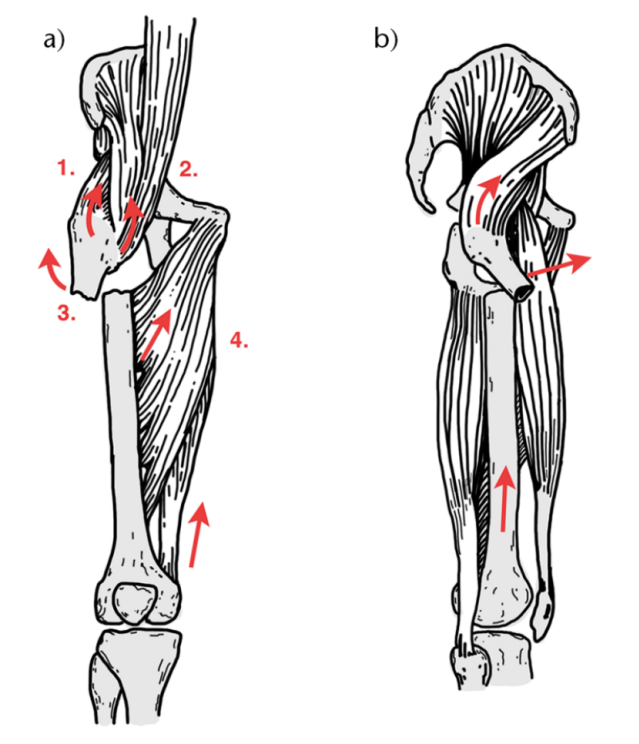
Figur 1: Deformerende kræfter (røde pile) på den proximale og distale fragment i koronarplan (A) og sagittalplan (B) ved subtrokanteriske frakturer. Det proximale fragment abduceres af gluteus medius og minimus (1), flekteres af iliopsoas (2) og eksternt roteres af de korte eksterne rotatorer (3). Det distale fragment adduceres og forkortes af adduktorerne og gracilis (4).
Klassifikation
Der findes flere klassifikationssystemer for subtrokanteriske (ST) lårknogelfrakturer. Russell-Taylor-klassifikationen er baseret på involvering af den lille trokanter og om frakturen udvider sig ind i piriformis-fossen. Før udviklingen af trokanterisk indgangsnagler blev denne klassifikation brugt til at skelne mellem frakturer, der er egnet til intramedullær naglebehandling, og dem, der kræver laterale fastvinklede fremmedlegemer. Russell-Taylor-type-I-frakturer involverer ikke piriformis-fossen og kan behandles med intramedullær naglebehandling via en indgang i piriformis-fossen.
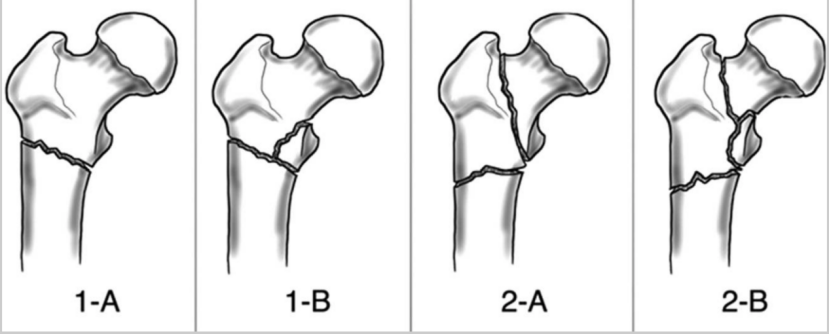
Kilde: Rizkalla JM, Nimmons SJB, Jones AL. Klassifikationer i kort form: Russell‑Taylor-klassifikationen af subtrokanteriske hofteskader. Clin Orthop Relat Res. 2019 jan;477(1):257‑261. doi: 10.1097/CORR.0000000000000505. PMID: 30586343; PMCID: PMC6345285.
Figuren viser de fire skadetyper, der er defineret i Russell‑Taylor-klassifikationssystemet:
Type 1‑A: Skaden omfatter ikke piriformis-fossen.
Type 1‑B: Skaden omfatter ikke piriformis-fossen, men omfatter den mindre trokanter.
Type 2‑A: Skaden går gennem piriformis-fossen, men omfatter ikke den mindre trokanter.
Type 2‑B: Skaden omfatter både den mindre trokanter og piriformis-fossen.
AO/OTA-klassifikationen har fordelene ved universalitet. Det er værd at bemærke, at der indtil videre ikke synes at findes et enkelt klassifikationssystem, der er ideelt til at vejlede behandlingen, forudsige prognosen og opnå tilfredsstillende interobserver-reproducerbarhed.
To specifikke ST-frakturmønstre kræver anerkendelse – omvendt skrå frakturer og atypiske frakturer.
Omvendt skrå frakturer er intertrokanteriske eller subtrokanteriske (afhængigt af den proksimale udstrækning af frakturen) læsioner, hvor den primære frakturlinje løber fra proksimal-medial til distal-lateral. Disse frakturer har tendens til medial skulderforskydning, har en høj implantatfejlrate ved kirurgisk behandling med en glidende hofteskruer og behandles bedst med intramedullær nailing.
Atypiske brudmønstre er forbundet med brug af bisfosfonater. Ved atypiske lårknoglebrud er det vigtigt at identificere de primære underliggende risikofaktorer: disse brud har en relativt høj forekomst af bilateral involvering; hvis der forekommer en ufuldstændig læsion i den laterale lårknoglekorteks, bør profylaktisk fiksering udføres for at undgå progression til et komplet brud. Det anbefales at afbryde behandling med bisfosfonater og skifte til andre lægemidler. American Society for Bone and Mineral Research har klassificeret de almindelige radiografiske karakteristika ved atypiske ST-brud i store og mindre kriterier. Fire af de fem store kriterier skal være opfyldt for at definere et brud som atypisk, mens de mindre kriterier kan være til stede eller fraværende individuelt. Store kriterier omfatter: lavenergi-traume, minimal komminution, et tvært brud, der udgangspunktet er den laterale korteks, tykkelse af den laterale korteks og en medial spids forbundet med et komplet brud.
Klinisk evaluering
Den kliniske præsentation af patienter med subtrokantere frakturer viser en bimodal fordeling. Hos yngre patienter skyldes subtrokantere frakturer typisk højenergisk trauma, såsom bilulykker eller fald fra højde. Dette skade-mekanisme er ofte forbundet med andre traumatiske skader, og patienten bør derfor gennemgås omfattende af traumaholdet. Hos ældre patienter skyldes subtrokantere frakturer normalt lavenergisk trauma og forekommer ofte som isolerede skader. Kirurgen skal indsamle en detaljeret anamnese og vurdere komorbiditetsforhold samt medicinbrug, især brugen af bisfosfonater og varigheden af behandlingen.
Klinisk undersøgelse af det påvirkede lem viser typisk forkortelse og ekstern rotation. Patienten klager over hoftesmerter og/eller lårsmerte, utilitet til at bære vægt og smerte ved hoftens bevægelser. Selvom disse frakturer normalt er lukkede skader, bør der foretages en hudundersøgelse, da den markante fleksion af det proximale fragment kan true den overliggende hud. Den kliniske undersøgelse skal omfatte vurdering af integriteten af de omkringliggende neurovaskulære strukturer. En fuldstændig skeletundersøgelse skal udføres for at udelukke tilknyttede ortopædiske skader. Når andre skader i den samme benhalv er udelukket, kan patienten placeres i træk, hvilket kan hjælpe med at genoprette frakturlængden og forbedre præoperativ smertevurdering.
Billeddiagnostisk evaluering
Passende billeddiagnostiske undersøgelser er afgørende for korrekt identifikation og klassificering af bruddet og udgør grundlaget for præoperativ planlægning. Hos patienter med mistanke om ST-brud bør den indledende billeddiagnostiske undersøgelse inkludere: anteroposterior (AP) bækken, AP- og laterale billeder af lårbenet samt AP- og laterale billeder af knæet. Billeddiagnostik af det modsatte lårben kan være nyttig til vurdering af lårbenets anteversion. Ved komminuerede brud, hvor kortikale anatomisker referencepunkter til anatomisk reduktion mangler, er billeder af det modsatte lårben særligt nyttige. CT-scanning er ikke rutinemæssigt påkrævet, men udføres ofte som en del af den indledende traumaevaluering; CT-billederne bør gennemgås omhyggeligt. CT giver en mere omfattende vurdering af brudmorfologien, herunder bruddets udstrækning proximalt. Denne information påvirker præoperativ planlægning, reduktionsmetoder og implantatvalg. Klassiske radiografiske fund ved ST-brud inkluderer: abduktion, ekstern rotation og fleksion af det proximale fragment samt adduktion af det distale fragment.
Behandling
Ikke-operativ behandling af ST-frakturer er generelt ikke mulig. Uden kirurgisk reduktion og fiksering har patienter en høj risiko for forkert knoglestilling eller ufuldstændig knoglehelning; endnu vigtigere er, at patienter bliver ikke-ambulatoriske, hvilket fører til øget mortalitet. De få patienter, der eventuelt kan overvejes til ikke-operativ behandling, omfatter dem, der ikke kan tolerere kirurgi på grund af uacceptabelt høje anæstesi-relaterede risici, eller dem, der modtager hospicebehandling med kun milde hoftesymptomer. Dog da kirurgi giver smertelindring og forbedret mobilitet, bør alle parter involveret i beslutningsprocessen grundigt drøfte ikke-operativ behandling, inden der fortsættes.
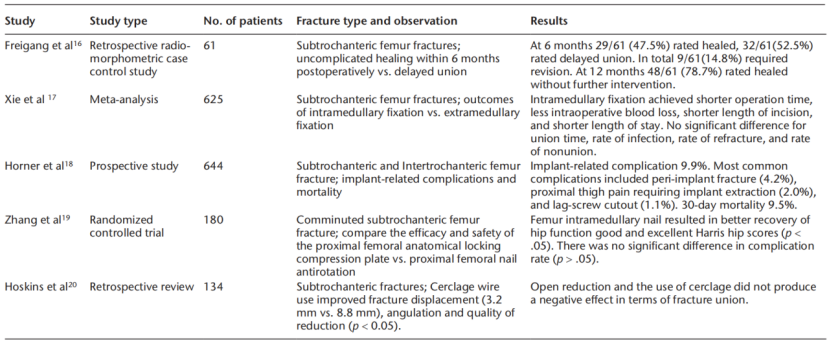
Kirurgisk behandling af ST-frakturer kan groft opdeles i to hovedkategorier: intramedullær sømfixering (IM) og ekstramedullær pladefixering (figur 2; tabel 1). Af disse er intramedullær sømning blevet standardbehandlingen af flere grunde – kortere ophold på sygehus, mindre blodtab, kortere samlet operationsvarighed, umiddelbar vægtbæring og bedre funktionelle resultater. Data viser, at langt den overvejende del af ST-frakturer behandles med intramedullære sømme. Intramedullære sømme giver også biomekaniske fordele, herunder højere stivhed og styrke samt en kortere momentarm, hvilket betyder en stærkere konstruktion og mindre belastning på implantatet. Sømmens indgangspunkt og implantatdesign påvirker frakturreduktion og stabilitet; derfor bør kirurger forstå de justerbare faktorer, der kan forbedre resultaterne.
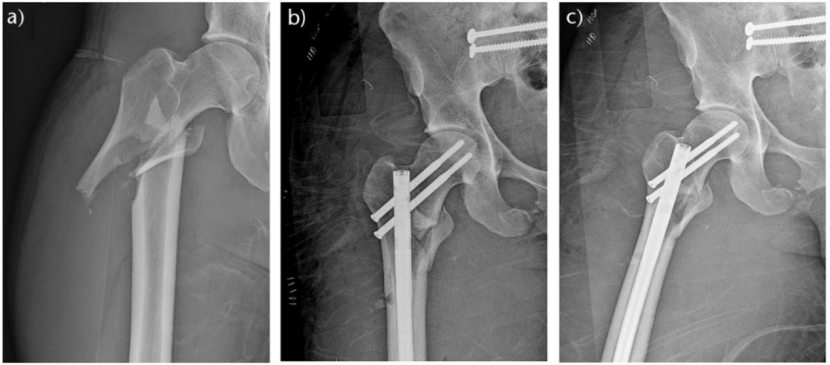
Figur 2: Røntgenbilleder af en subtrokanterisk knoglebrud i højre lårknoglen (med intertrokanterisk udstrækning). A: Præoperativt anteroposteriort billede. B: Umiddelbart postoperativt anteroposteriort billede. C: Umiddelbart postoperativt lateralt billede. Dette knoglebrud blev behandlet med en rekonstruktions intramedullær søm via en piriformis-fossa-indgang.
Tabel 1: Aktuel evidens for subtrokanteriske lårknoglebrud (kun titel, ingen detaljerede indhold angivet i originalen).
Hvad angår indgangspunktet, kan kirurgen vælge enten piriformis-fossa- eller trokanter-indgangen. Ved begge fremgangsmåder skal snittet udføres proksimalt til og justeret efter akseretningen for knoglemarvskanalen i lårbenet, så den øverste gluteale nerve undgås. Et mere posteriort snit gør det muligt at indføre guidetråden fra posterior til anterior, hvilket er i overensstemmelse med den anatomiskes kurvatur i lårbenet. Dette reducerer risikoen for eksentrisk frese af det proksimale fragment i sagittalplanet. Piriformis-fossa-indgangen har den fordel, at en lige spænder står i linje med koronaraksen i lårbenets knoglemarvskanal. Denne kolinearitet reducerer risikoen for varus-fejlforbindelse og minimerer også risikoen for eksentrisk frese af den mediale kortikalis. Dog er piriformis-fossa-tilgangen mere udfordrende hos overvægtige patienter. For meget anterior placering øger risikoen for perforation af den anteriore kortikalis. Trokanteriske indgang er mere overfladisk og kan let reducere bløddelsdissektionen. Dog krænker den abduktorers indfæstning. Desuden indebærer trokanterisk indgang en højere risiko for varus-fejlforbindelse. Yderligere fører den betydelige anatomiske variation i trokanteren mellem patienter til stor kirurgisk variation. Overordnet set bør valget af indgang individualiseres med hensyn til patientens anatomi, kirurgens præference, frakturkarakteristika og omfanget af frakturmønsteret.
Til behandling af ST-frakturer er den ideelle intramedullære søm en antegrad cephalomedullær søm. Denne søm kræver statisk distal låsning. Den sikrer proximal fiksering inden for lårknoglenes hals og hoved. Mulighederne omfatter en stor cephalomedullær skruer eller en spiralformet bladskruer. Disse fremmedlegemer virker imidlertid primært ved frakturkompression og er derfor mere anvendelige ved intertrokanteriske frakturer. Alternativt kan to mindre rekonstruktionsskruer anvendes. Dette reducerer knoglefjernelse i lårknoglenes hals og hoved, samtidig med at der stadig opnås tilstrækkelig proximal fiksering. Andre fordelagtige egenskaber ved sømmen omfatter en større proximal diameter og brug af en fuldlængdesøm. I forhold til korte sømme forbedrer fuldlængdesømme både rotationel og aksial stabilitet. Dette øger den samlede konstruktioners styrke og mindsker også risikoen for postoperativ periprotesisk fraktur. Anvendelsen af to distale låseskruer giver større rotationel og aksial stabilitet end én enkelt skrue.
Den anden store kategori af kirurgisk fiksering til ST-frakturer er brugen af låseplader eller fastvinklede ekstramedullære plader. Implantation af fastvinklede knoglebladplader er teknisk krævende. Denne faktor kombineret med lavere knoglehelingsrater, længere operationsvarighed, længere tid til vægtbæring og højere infektionsrater sammenlignet med intramedullær nailing har ført til en tilbagegang i deres anvendelse. Låseplader har vist bedre biomekanisk ydeevne end fastvinklede knoglebladplader. Studier af Collinge et al. har dog vist, at disse konstruktioner førte til fikseringsfejl, forkert justering/forkert heling og dybe infektioner hos over 40 % af patienterne; mere end en tredjedel af disse patienter krævede reoperation. Ikke desto mindre har ekstramedullære plader stadig en rolle, især når åben reduktion er påkrævet, ved brug af småfragmentplader som midlertidig fiksering. Med denne teknik til midlertidig pladering er andelen af forkert heling reduceret fra 27 % til 0 %.
Reduktionsstrategier og -teknikker
På grund af de deformerede kræfter, der virker på ST-frakturer, kan en række teknikker anvendes til at opnå anatomiisk reduktion. Disse reduktionsteknikker omfatter: brug af reduktionsklemmer, en kugle-spids-pusher kombineret med en knogehook, perkutane Schanz-nåle som joystick, en femoral distraktor, fingerlignende reduktionsværktøjer, blokerings-skruer eller -tråde samt cerclage-tråde. Den præoperative patientpositionering bør tage hensyn til kirurgens vaner og præferencer, da hver position har sine fordele og ulemper. For eksempel kan adduktion af det påvirkede lem i lateral decubitus-stilling lette adgangen hos overvægtige patienter, og denne position gør også reduktionen af det distale fragment lettere. Supinastillingen er velkendt for de fleste kirurger, har fordele i tilfælde af polytrauma ved at give adgang til andre lemmer og beskytter en skadet rygsøjle.
For mange ST-frakturer kan reduktionsklemmer overvejes for at hjælpe med at opretholde reduktionen (figur 3). Denne teknik giver gode reduktionsresultater og høje unionsrater. For simple to-dels ST-frakturer kan perkutane Schanz-pinde anvendes som joysticker, eller en kugle-spids-pusher i kombination med en knoglehage, for at justere fragmenterne og muliggøre korrekt placering af guidetråden. Schanz-pinde kan også bruges i kombination med en femoral distraktor til først at genoprette frakturlængden og derefter låse reduktionen, når en tilfredsstillende justering er opnået.
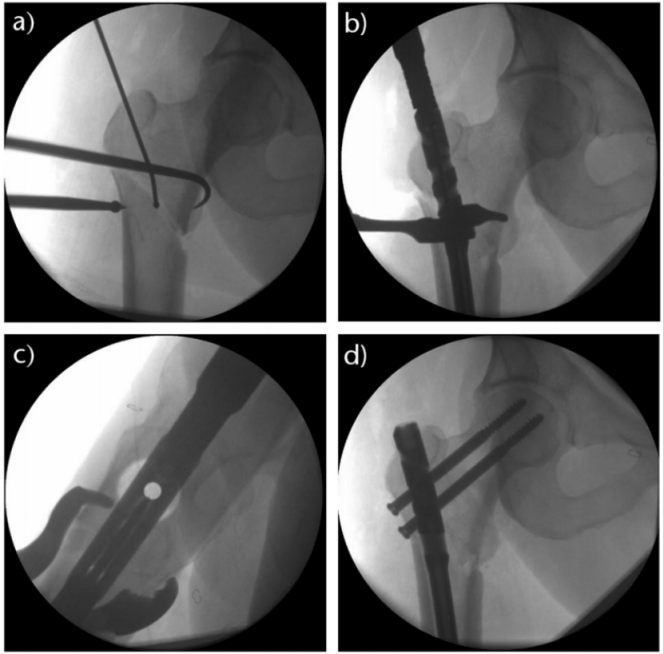
Figur 3: Anvendelse af en kugle-spids-pusher til at skubbe det distale fragment medialt, mens en knoglehage trækker det proximale fragment tilbage for at korrigere varus-deformitet (A). Efter placering af guidetråden opretholder reduktionsklemmer reduktionen i koronale (B) og sagittale plan (C). Når anatomiisk reduktion er opnået, fikseres subtrokanterisk fraktur med en rekonstruktionsintramedullær søm via trokanterisk indgang (D).
For to-dels ST-frakturer er et fingerformet reduktionsværktøj meget nyttigt (figur 4). Langsgående træk forbedrer generelt længden, men da abduktorernes indfældningssted er proximalt og adduktorernes distalt, vil varus-fejlstilling ofte vedblive; det fingerformede værktøj kan derefter kontrollere det proximale fragment for at korrigere varus. Forkert indgang eller trajektori for guidestift kan føre til excentrisk boremning, hvilket kan resultere i kortikal perforation eller forstyrre en allerede opnået reduktion. For mere komplekse frakturmønstre (med komminution eller distal udstrækning) kan blokerings-skruer eller -tråde anbringes på den konkave side af den proximale fragments deformitet for at opretholde reduktionen og øge konstruktionens stivhed (figur 5). Selvom der er bekymringer for, at blodforsyningen til femuren kan kompromitteres, har percutane cerclage-tråde vist sig at være en effektiv og sikker metode til reduktion.
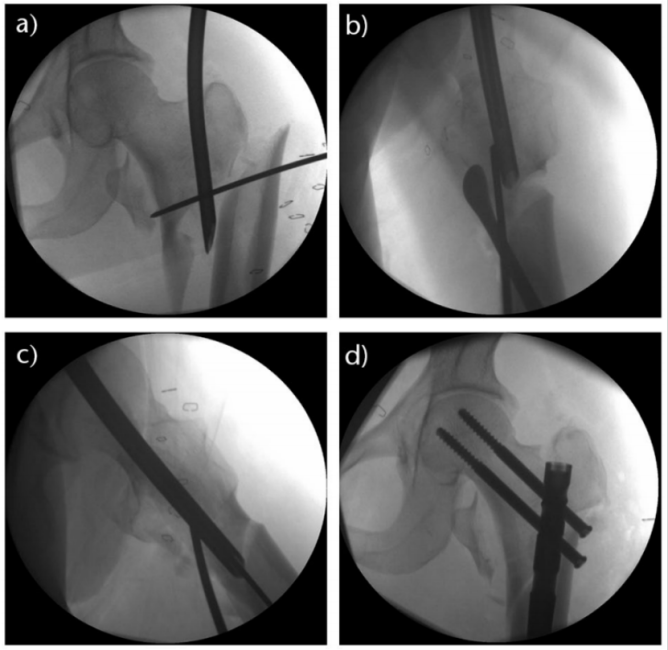
Figur 4: Flere reduktionsteknikker anvendes til denne komplekse subtrokanteriske fraktur med intertrokanterisk udstrækning. Et fingerlignende reduktionsværktøj placeres gennem en piriformis-fossa-indgang for at kontrollere det proximale fragment (A). En Cobb-elevator og en posterior blokeringswire bruges til at korrigere sagittal deformitet (B). Det fingerlignende værktøj fremskubbes derefter til niveauet af det distale fragment for at muliggøre passage af guidetråden (C). Når anatomiisk reduktion er opnået, opretholdes reduktionen med en piriformis-fossa-indgangs rekonstruktionsintramedullær søm (D).
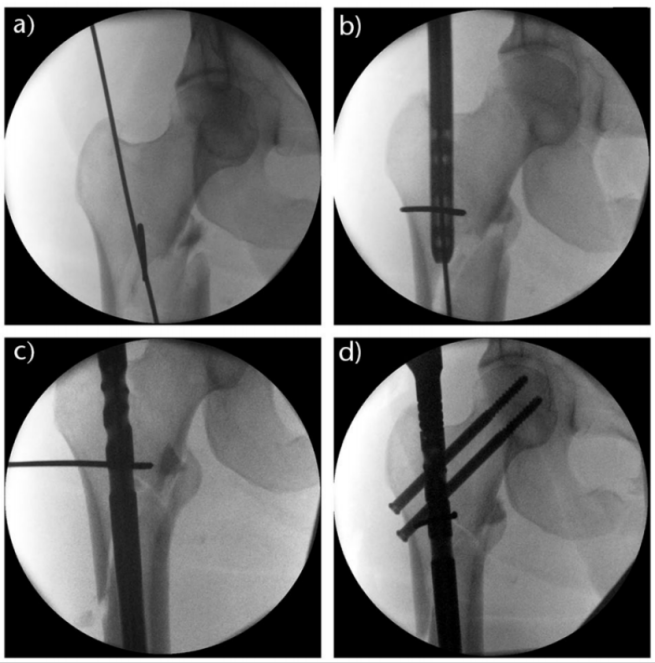
Figur 5: En blokeringswire placeres på den konkave side af deformiteten i det proximale fragment, medialt i forhold til guidetråden, og efterlades på plads under fremdrift for at styre fremdriften af det proximale fragment (A). Under indføring af sømmen (B) forskyder blokeringswiren effektivt det distale fragment lateralt (C), hvilket dermed opnår anatomiisk reduktion, som opretholdes med en piriformis-fossa-indgangs rekonstruktionsintramedullær søm (D).
Komplikationer
Kirurgiske komplikationer ved ST-frakturer er tilsvarende dem ved andre proximale femurfrakturer og omfatter forkert knoglestilling (malunion), ufuldstændig knoglestilling (nonunion), infektion, implantfejl og død. Dødelighedsraterne inden for 30 dage, 1 år og 4 år efter ST-frakturer er henholdsvis ca. 9,5 %, 27 % og 60 %.
En af de mest almindelige komplikationer efter intern fiksering af ST-frakturer er varus- eller procurvatum-forkert knoglestilling (malunion) eller ufuldstændig knoglestilling (nonunion). Denne risiko er primært forbundet med suboptimal intraoperativ anatomic reduktion; konsekvent anvendelse af korrekte reduktionsteknikker bør forbedre justeringen og mindske komplikationer relateret til helbredelse.
Misforbindelse kan også omfatte rotationsdeformitet, hvilket kan føre til gangafvigelser og hoftpine. Rotationsmisjustering er især almindelig, når et trækkedebet anvendes, da der ofte anvendes overdreven indre rotation for at forsøge at reducere bruddet. Dette er især bekymrende ved alvorligt komminuerede brud. Hvis bruddet helbreder i den typiske ST-misreduktionsmønster, vil overdreven varusvinkel og fleksion af det proksimale fragment negativt påvirke patientens gangmekanik. Symptomatisk misforbindelse kan kræve osteotomi og intern fixation; ikkehelbredelse kan effektivt behandles med udskiftning af implantatet, med eller uden knogletransplantation. Som ved alle operationer er infektion en potentiel risiko. Overfladiske infektioner kan ofte behandles alene med antibiotika. Dybe infektioner kræver imidlertid kirurgisk spülning og debridement og kan kræve fjernelse af implantatet. Ved inficeret ikkehelbredelse kræves fjernelse og udskiftning af implantatet til et antibiotikabelastet intramedullært implantat samt langvarig intravenøs eller oral antibiotikabehandling.
Konklusion
Subtrokanteriske (ST) lårknoglefrakturer er udfordrende. De deformerede kræfter er store og komplekse, hvilket gør reduktion og fiksering svær. Kirurgi forbliver den endelige behandling af disse frakturer, og det er afgørende at forstå disse kræfter samt teknikkerne til korrekt reduktion for at forbedre alignment, stabilitet og patientresultater.
Referencer:
1. Subtrokanteriske lårknoglefrakturer: aktuel oversigt over behandling.
2. Klassifikationer i kort form: Russell-Taylors klassifikation af subtrokanterisk hoftesvigt.