EN


MIPO Plate Fixation for Simple Oblique Tibial Fractures
Indications
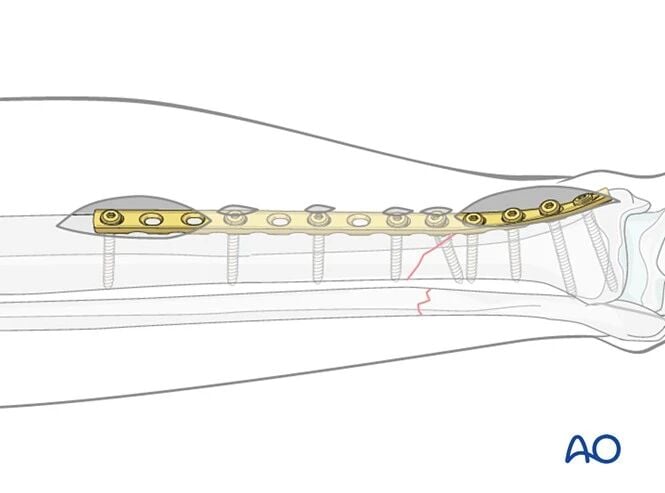
- Compression plating can be used for any simple oblique tibial fracture.
- Compression plating is particularly suitable for fractures in children with significant displacement that require anatomic reduction and in whom the growth plates are still open.
- Minimally invasive osteosynthesis (MIO) is suitable for selected simple oblique fractures, provided that closed reduction can effectively restore anatomic alignment.
General Considerations
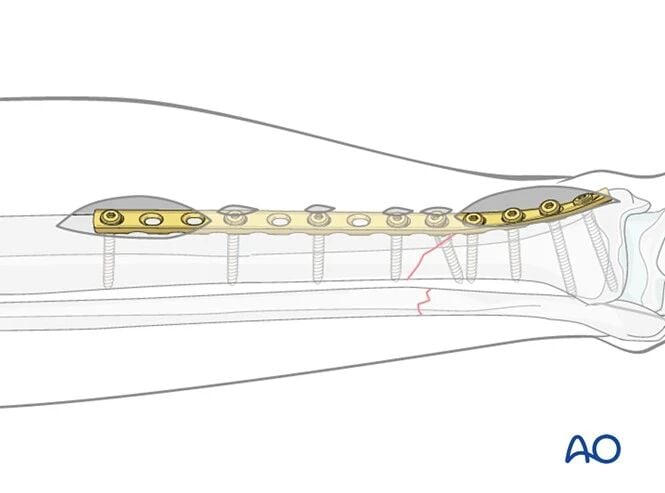
Tibial shaft fractures close to the knee or ankle joint may require plate fixation. The advantage of MIO is that it preserves the biological environment of the fracture site. By reducing skin incisions and surgical dissection and by using indirect reduction techniques and basic plating principles, adequate fixation and alignment can be achieved without causing significant injury to bone or soft tissues.
Multifragmentary fractures require bridging techniques, whereas short oblique or transverse fractures should be fixed with compression plates to achieve absolute stability and avoid the high strain that occurs in simple fractures when compression fixation is not used.
Reduction
Pointed Reduction Forceps
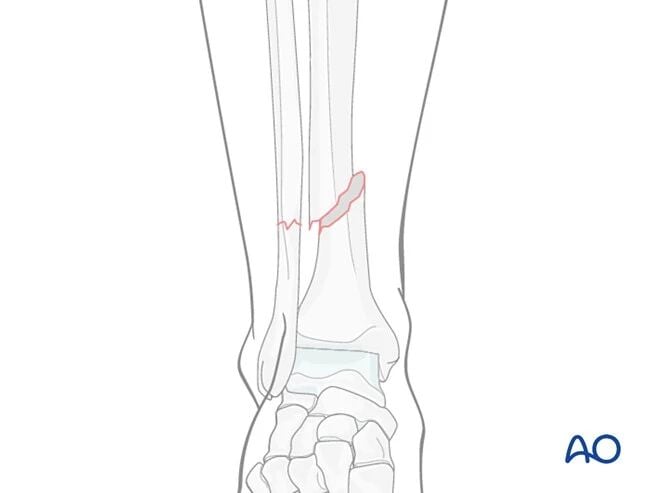
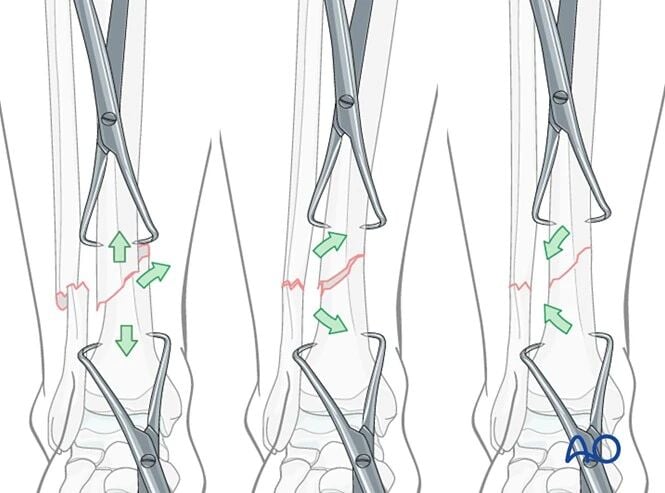
Precise reduction of the fracture site is critical for compression plate fixation (absolute stability). When possible, reduction forceps are a very valuable adjunct. Pointed reduction forceps can be used percutaneously for oblique fractures.
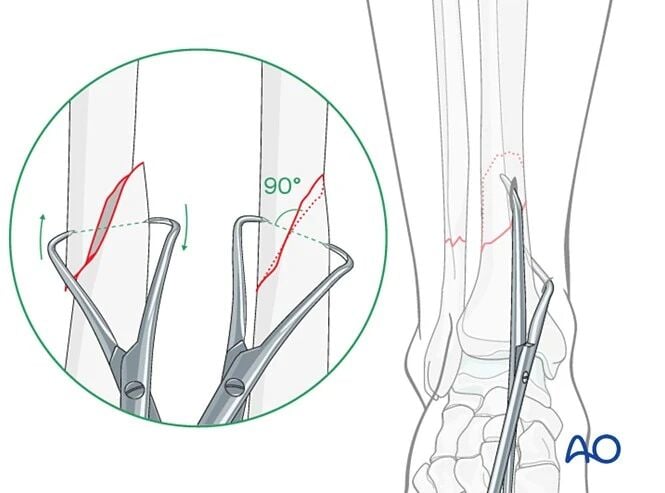
The placement of the reduction forceps is critical. After restoring length, each forceps tip must be pre-positioned at the location it will occupy after fracture reduction. As shown in the schematic, the forceps teeth should be placed perpendicular to the fracture surface.
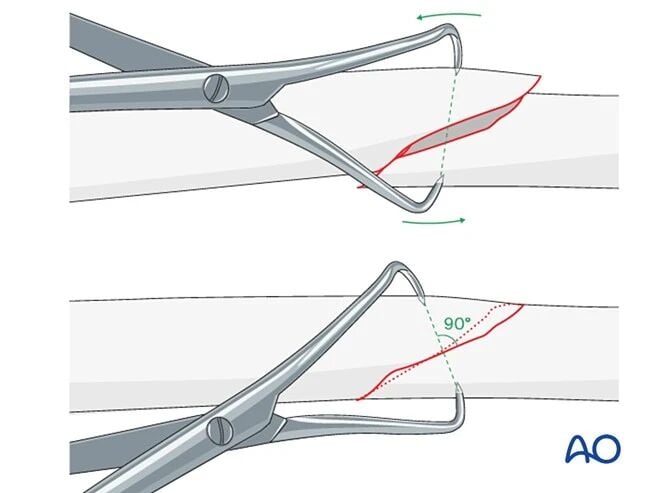
For transverse fractures, reduction forceps cannot be used to directly compress the fracture surface. In this situation, placing one percutaneous pointed reduction forceps on each fracture fragment helps adjust the fracture.
Adjustable Tension Device (ATD)
To use the adjustable tension device (ATD) in distraction mode, first fix the pre-bent plate to the distal fracture fragment. Then apply a distraction force to the other end of the plate with the ATD.
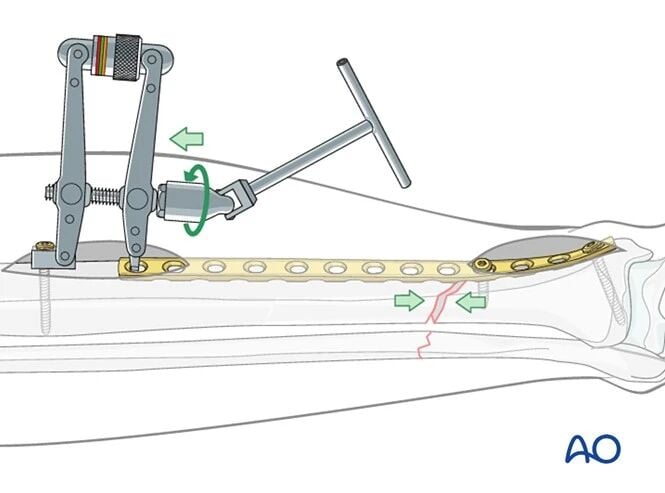
Distraction facilitates precise reduction of the fracture surfaces. Once the fracture is satisfactorily reduced, switch the ATD to compression mode and load the fracture to achieve interfragmentary compression and absolute stability.
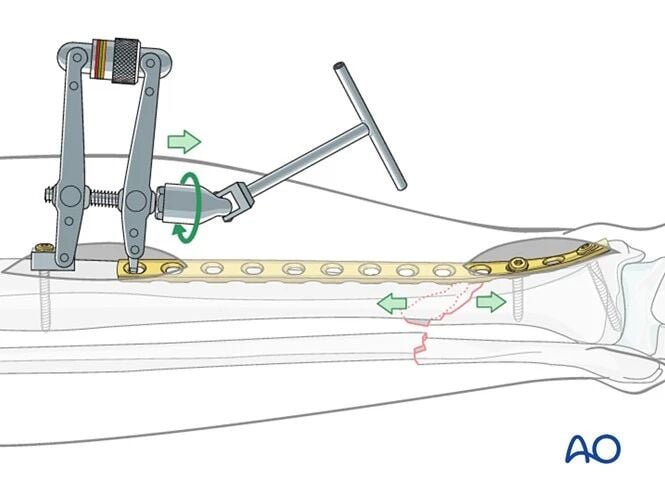
Depending on the position of the plate relative to the fracture plane, slight overbending of the plate at the fracture may be required so that compression is generated both on the opposite side of the plate and in the adjacent area.
Push-Pull Screw
Fix the pre-bent plate to one main fracture fragment. Then insert a bicortical push-pull screw proximal to the end of the plate and use a laminar spreader to apply distraction through the plate, distracting the fracture ends to facilitate reduction. After satisfactory fracture reduction, use Verbrugge forceps between the push-pull screw and the plate to apply fracture-end compression.
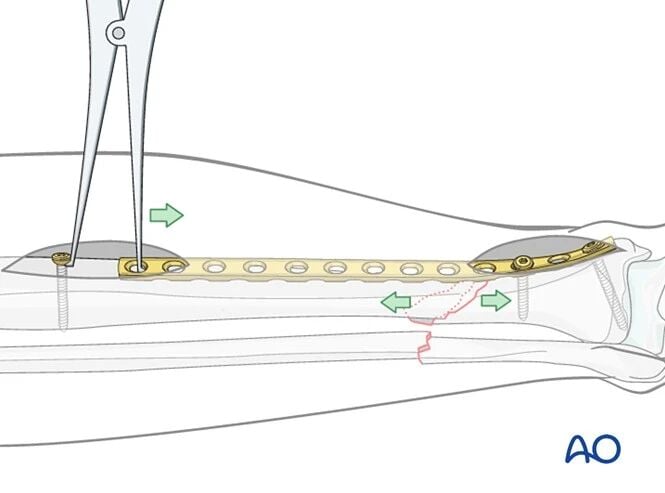
Depending on the position of the plate relative to the fracture plane, slight overbending of the plate at the fracture may be required so that compression is generated both on the opposite side of the plate and in the adjacent area.
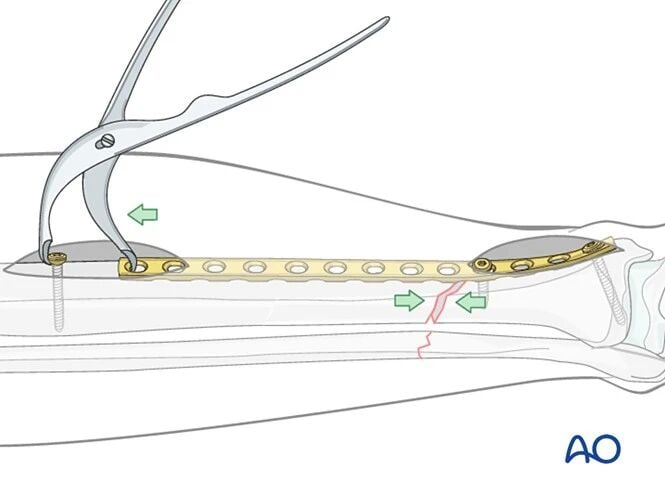
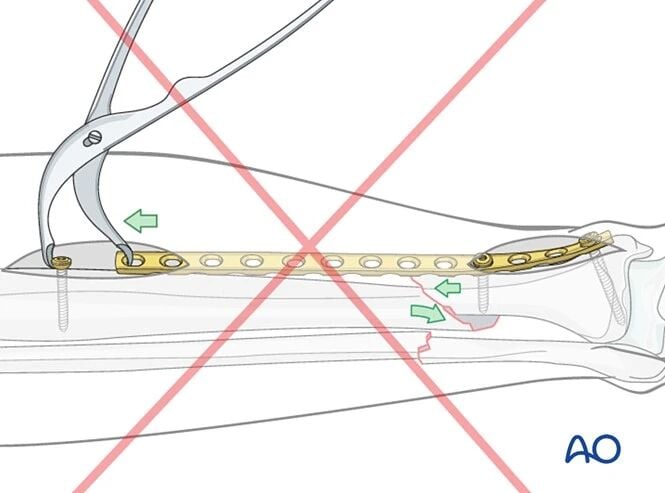
⚠️ Note: When performing compression plate fixation for an oblique fracture, an “axilla” (acute angle) must be created between the plate and the fixed bone segment.
As shown in the schematic, if the first compression screw or Verbrugge forceps is placed at the opposite end of the plate, compression will cause instability and poor reduction.
Final Fracture Reduction
Reduction Forceps
Final reduction is achieved by inserting pointed reduction forceps through two small incisions. These forceps are usually placed along the trajectory of the planned lag screw.
Plate
Reduction can also be achieved by reducing the fracture to the plate. After fixing the plate to one fracture fragment, a well-positioned cortical screw can pull the adjacent fragment toward the plate, thereby correcting fragment displacement.
For this technique to be effective, the plate must be contoured to fit the bone surface. The surgeon must also ensure that reduction is adequate in the orthogonal plane (not only in the AP view shown, but also on the lateral view).
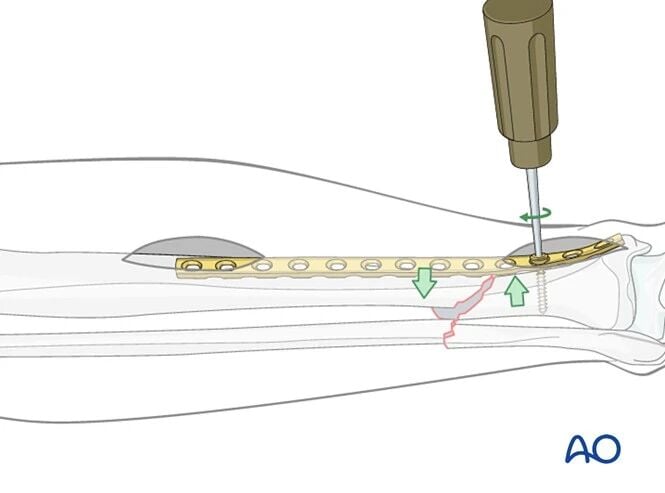
Plate Selection and Preparation
Plate Selection
Plate length is based on symmetry above and below the fracture zone. At least 3–4 screw holes are needed on each side of the fracture.
Another guideline is that, if fracture location permits, the plate length should be approximately three times the length of the fracture zone.
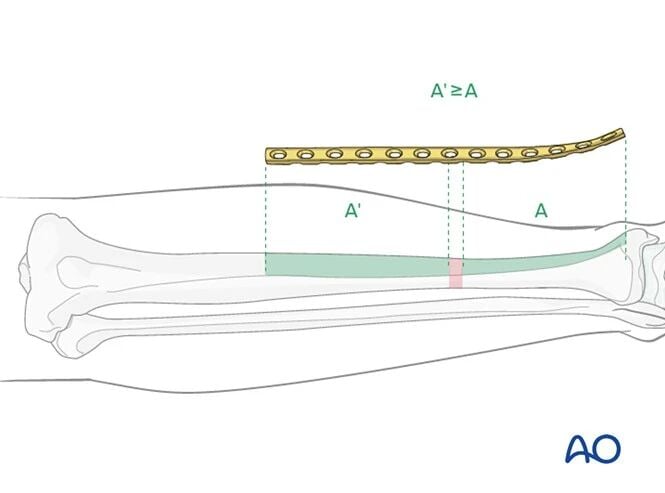
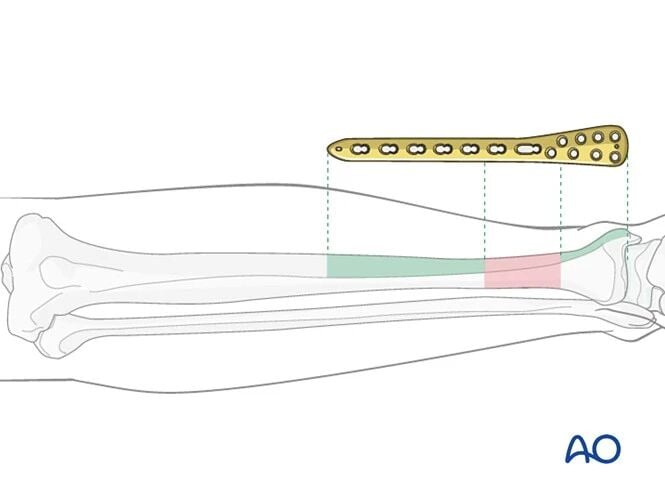
In general, a long plate with fewer screws is most effective. If the fracture is very close to the distal or proximal end, there may not be enough space in the short segment near the articular surface for a symmetrically long plate. In this case, a plate with multiple screw hole options in the metaphysis should be selected to improve fixation in the short periarticular segment.
If bone quality is poor or the fracture extends into softer metaphyseal bone, a locking plate may be required.
Compression Screws
After reduction, apply fracture-end compression. This can be achieved with an adjustable tension device (ATD) or a push-pull screw combined with Verbrugge forceps.
For a well-reduced fracture, additional compression can be applied with a screw in the opposite main fracture fragment. This screw is inserted eccentrically through a guide into a hole of a dynamic compression (DC) plate.
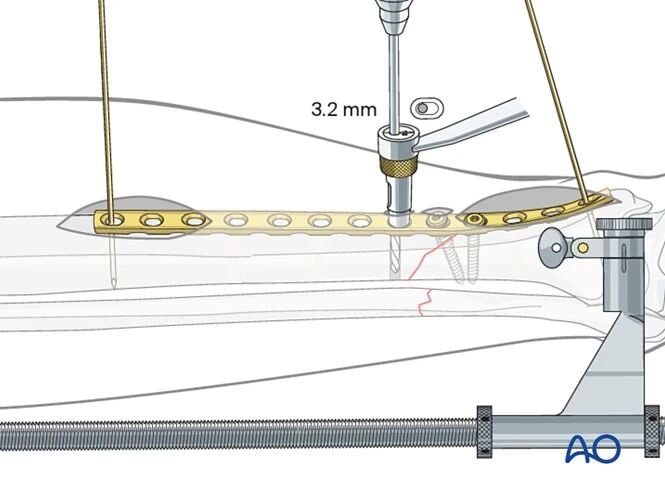
❇️ Tip: Percutaneous screw insertion
Screws can be inserted through the small incisions made when inserting the plate, from both ends of the plate. The positions of screw holes in the central portion of the plate can be localized by placing an identical-length plate on the skin and then marking the screw hole positions on the skin. Dedicated drill sleeves are now available to safely insert screws percutaneously through conventional plates. Alternatively, lateral fluoroscopy can help the surgeon determine the plate screw hole positions.
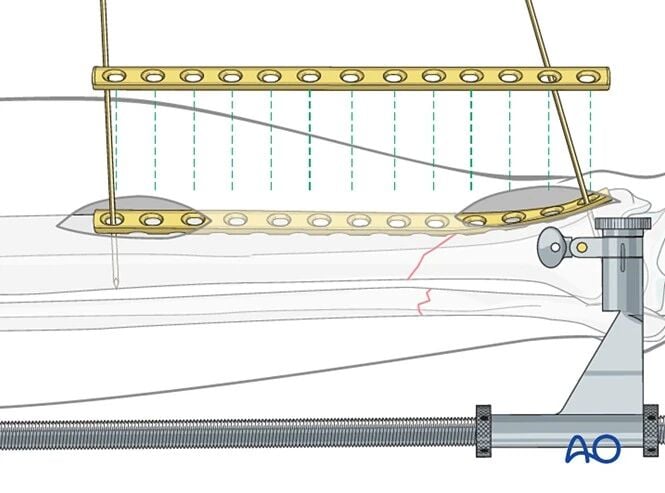
Interfragmentary Lag Screw
If greater stability is needed, an interfragmentary lag screw can be inserted through the plate to enhance structural stability.
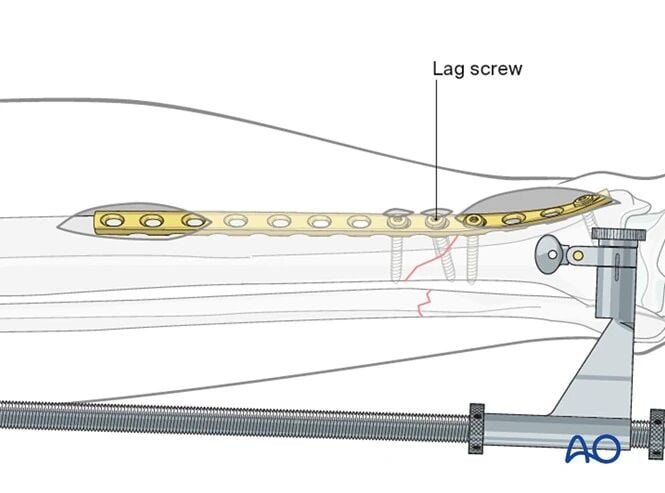
The interfragmentary lag screw can also be inserted perpendicular to the fracture surface without passing through a plate hole. This requires sufficient obliquity of the fracture. This screw should be inserted after plate compression has been completed.
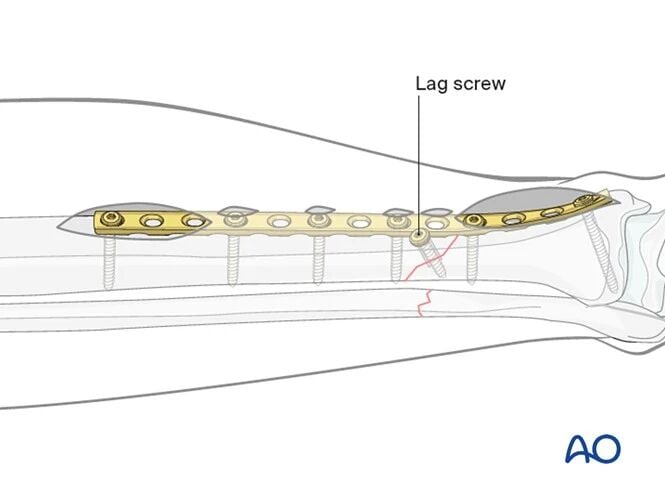
Insertion of Remaining Screws
Insert the remaining screws at appropriate intervals. Remember: long plate fixation is more effective, and fewer screws are needed in the diaphyseal segment. Replace excessively long screws with screws of appropriate length.