EN


Comparison of Outcomes of Cannulated Screws, Dynamic Hip Screw, and Femoral Neck System in the Treatment of Transcervical Femoral Neck Fractures
What Are the Differences in Reoperation Rates Among Three Internal Fixation Methods for Transcervical Femoral Neck Fractures?
This article was published in Orthopaedics & Traumatology: Surgery & Research, with Mark Ibraheem as first author. This two-center retrospective cohort study included 207 cases of internal fixation for transcervical femoral neck fractures from 2019 to 2024, divided into cannulated screws (CS; n=27), dynamic hip screw (DHS; n=100), and femoral neck system (FNS; n=80), with a minimum follow-up of 12 months. After adjustment for confounding variables, the reoperation rate for FNS was lower than that for CS; no statistically significant difference was observed in adjusted reoperation outcomes between FNS and DHS; no statistically significant difference was observed in fracture healing rates among the three groups; higher Garden classification grades were associated with increased complications. These results suggest that prospective studies are needed to supplement patient-reported outcome data.
Clinical dilemma of internal fixation for transcervical femoral neck fractures
Reoperation after internal fixation of femoral neck fractures remains an unavoidable clinical problem. Previous literature has reported reoperation rates ranging from 10% to 48.8%; despite decades of technological iteration, this figure has not improved substantially. Debate persists regarding how to choose among different internal fixation devices. The femoral neck system (FNS) is a relatively new internal fixation implant that uses a bolt combined with an anti-rotation screw to enhance rotational stability while maintaining a minimally invasive procedure. However, clinical evidence directly comparing FNS with cannulated screws (CS) and dynamic hip screw (DHS) in the same cohort remains limited. The study had a prespecified hypothesis: the reoperation rate associated with FNS fixation would be lower than that with CS and DHS. The study addressed three core questions: whether the internal fixation method affects reoperation, whether it affects fracture healing, and whether it affects postoperative complications. (Figure 1)
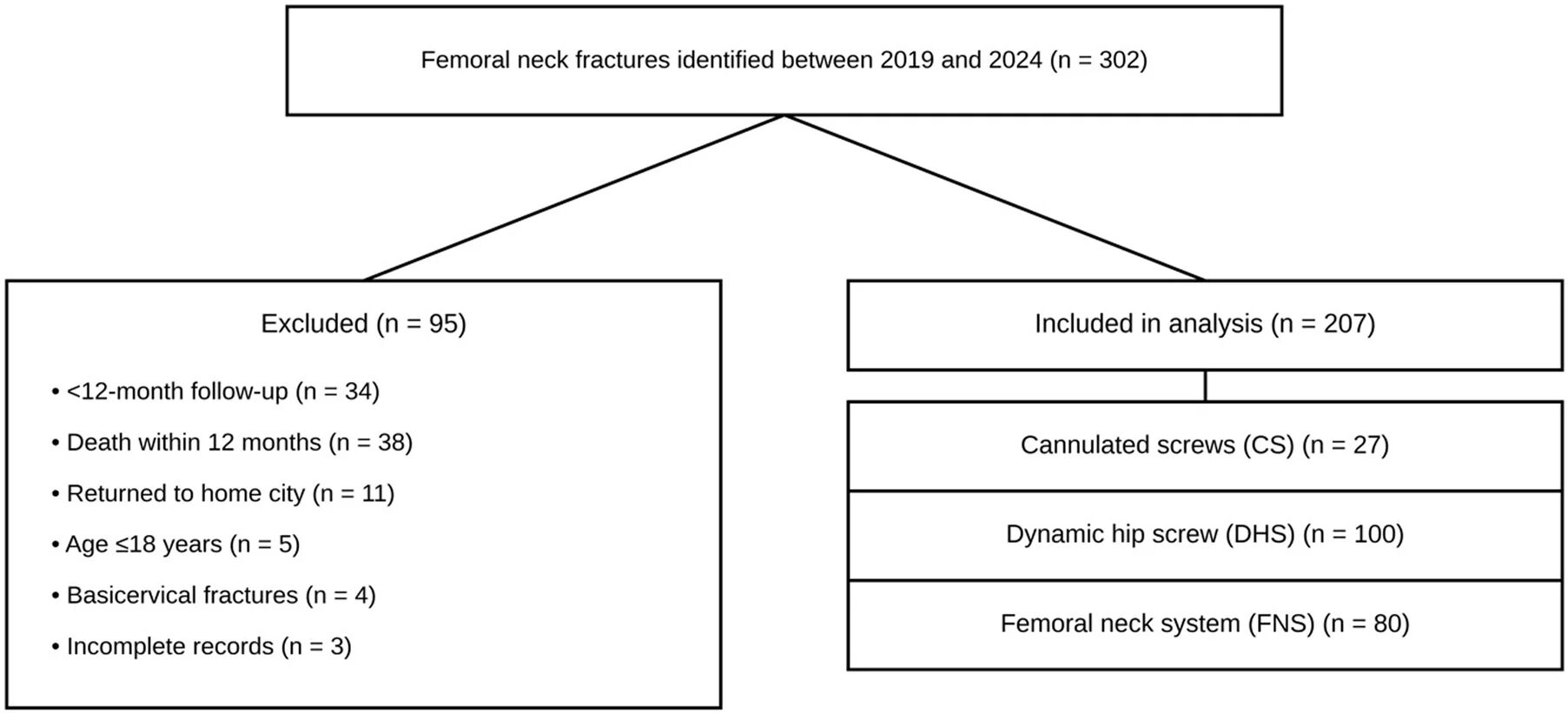
Figure 1. Flowchart of patient screening. A total of 302 patients were assessed for eligibility; 95 were excluded; ultimately, 207 were included in the analysis (CS n=27, DHS n=100, FNS n=80).
Cohort baseline and surgical implementation
This retrospective study retrieved cases from two centers between 2019 and 2024. A total of 302 patients with femoral neck fractures treated with internal fixation were screened, and 95 were excluded. Reasons for exclusion included follow-up of less than 12 months without records of fracture-related endpoint events, death within 12 months postoperatively, return to hometown, age ≤18 years, basicervical femoral neck fracture, and incomplete medical records. The final analytic sample comprised 207 patients (CS 27, DHS 100, FNS 80). (Tables 1 and 2)
All cases were transcervical femoral neck fractures. At both centers, Garden type IV fractures were treated directly with arthroplasty; therefore, the cohort did not include Garden type IV cases. Implant selection was at the discretion of the attending surgeon, with no standardized allocation protocol; selection was based on patient age, functional status, Garden classification, bone quality, and surgeon preference. CS all used a three-screw inverted-triangle configuration; DHS used a sliding hip screw with a side plate, without an additional anti-rotation screw in this cohort; FNS used a bolt combined with an anti-rotation screw and side plate construct. All three implants were products from the same manufacturer. (Figure 2)
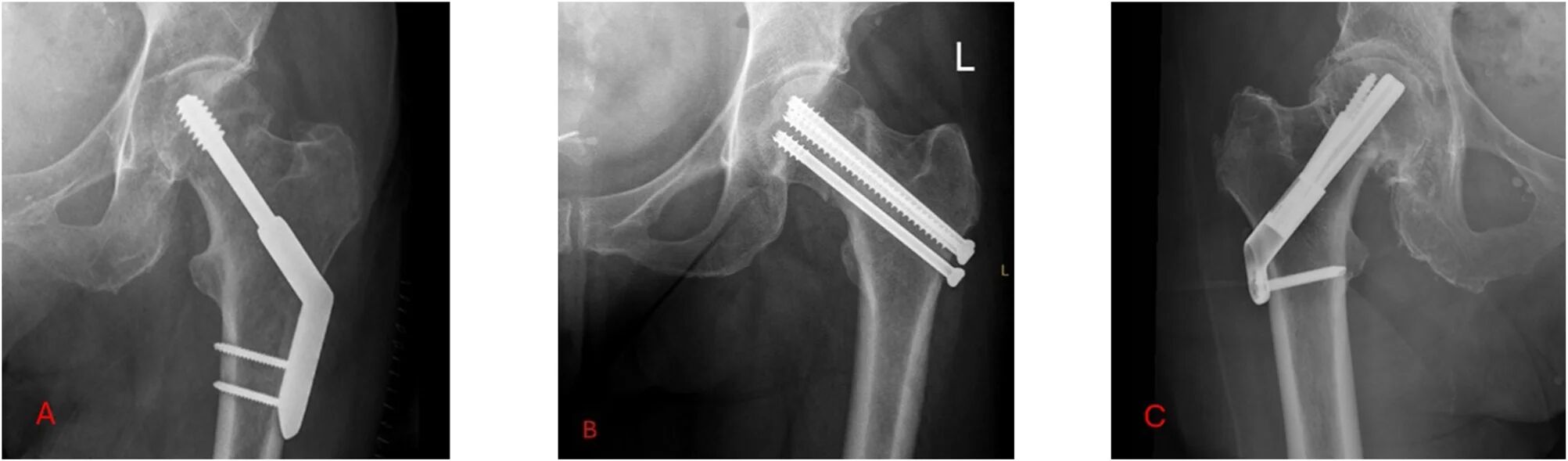
Figure 2. Anteroposterior pelvic radiographs of the three internal fixation devices. (A) DHS without an additional anti-rotation screw; (B) CS; (C) FNS with an anti-rotation screw.
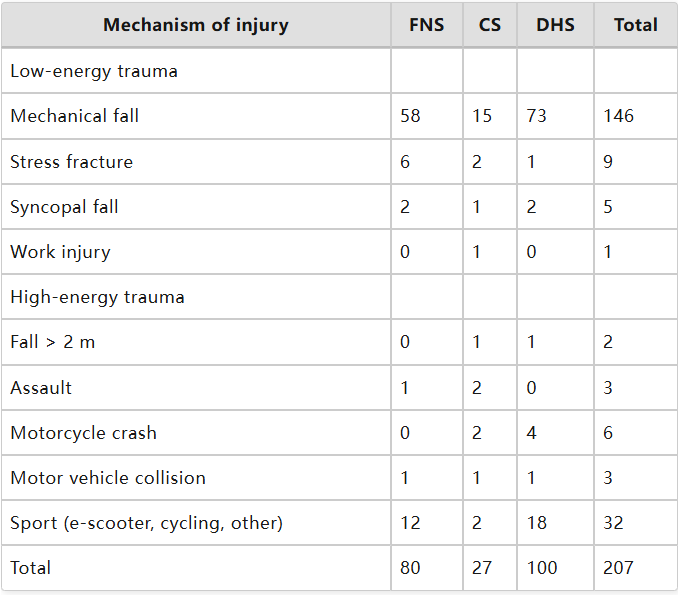
The investigators used the modified Garden classification and assessed displacement with reference to lateral radiographs in addition to anteroposterior views. Fracture healing was defined as trabecular bridging visible in at least 3 cortices, with no pain on weight-bearing. Reoperation was defined as any unplanned surgical procedure on the affected hip related to the index fracture or implant. Negative binomial regression was used to analyze surgical waiting time; logistic regression was used to analyze the associations between internal fixation method and healing, reoperation, and complications after adjusting for age, Charlson Comorbidity Index, Garden classification, side, and interval from injury to surgery. Baseline imbalance existed among groups: mean age was 54.8 years in the CS group, 66.9 years in the DHS group, and 68.2 years in the FNS group; Garden classification distribution also differed among groups, and the statistical models adjusted for these baseline differences. Most injuries were caused by low-energy falls. (Tables 1 and 2)
Primary and secondary outcome data
Reoperation occurred in 37/207 (17.9%) of the overall cohort: CS group 10/27 (37.0%), DHS group 20/100 (20.0%), and FNS group 7/80 (8.8%), with an unadjusted between-group p=0.004. After multivariable adjustment, compared with FNS, CS was associated with reoperation OR=5.26 (95% CI 1.53–18.13); for DHS versus FNS, OR=1.85 (95% CI 0.65–5.26), with no statistically significant difference. Overall fracture healing was 184/207 (88.9%), and there was no statistically significant association between internal fixation method and fracture healing (p=0.065). Overall complications were 61/207 (29.5%): CS group 11/27 (40.7%), DHS group 32/100 (32.0%), and FNS group 18/80 (22.5%), with an unadjusted between-group p=0.15. Higher Garden classification grade was independently associated with increased complications (Garden II OR 2.58, Garden III OR 3.44, p=0.037). Avascular necrosis of the femoral head occurred in 4/80 (5.0%) in the FNS group, 11/100 (11.0%) in the DHS group, and 2/27 (7.4%) in the CS group, p=0.42. Regarding surgical waiting time, the DHS group had a shorter time than the FNS group (IRR 0.49, 95% CI 0.35–0.69, p<0.001), but the median surgical waiting time was 1 day in all three groups.
Insights and limitations of the study
The cohort data show that, after adjustment for baseline confounders, the reoperation risk with FNS was lower than that with cannulated screws; however, no statistically significant difference was observed in adjusted reoperation outcomes between FNS and DHS. No significant difference in fracture healing rate was observed among the three internal fixation methods. This study was a retrospective, nonrandomized cohort with surgeon-related selection bias for implants, and baseline age and Garden classification distributions were unbalanced among groups; although multivariable models were used for adjustment, residual confounding could not be completely eliminated. The study did not collect Pauwels angle, posterior tilt angle, or Garden alignment index, and these variables could not be included in the analysis; the CS subgroup was small and the number of event variables was limited, raising the risk of model overfitting. The study lacked patient-reported outcome measures. The investigators proposed that prospective studies are needed to further validate the conclusions.
Table 1. Patient demographics and baseline clinical characteristics.
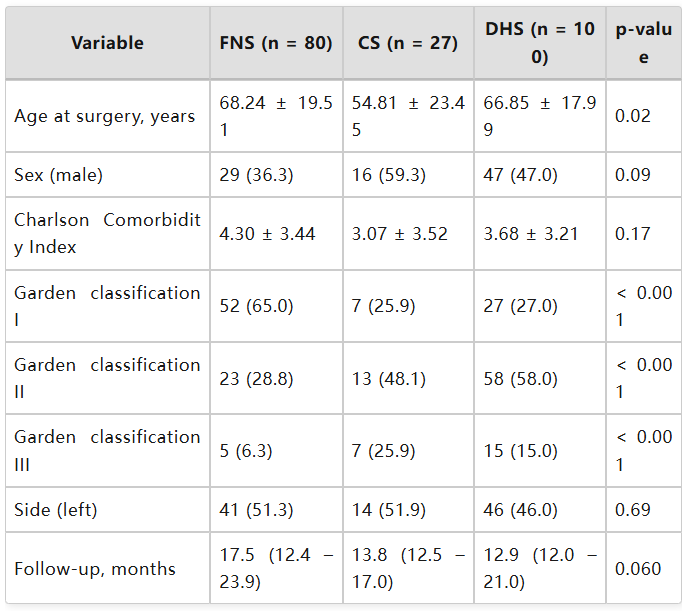
Table 2. Injury Mechanism Statistics
References
Ibraheem M, Milne L, Teo MKY, Blakeney W. Comparative outcomes of cannulated screws, dynamic hip screws and the femoral neck system for transcervical femoral neck fractures. A retrospective cohort study. Orthop Traumatol Surg Res. 2026;doi:10.1016/j.otsr.2026.104922.
Stoffel K, Zderic R, Sommer C, et al. Biomechanical comparison of the femoral neck system versus cannulated screws for femoral neck fracture fixation. J Orthop Trauma. 2021;35(8):425‑431. doi:10.1097/BOT.0000000000002078.
Bhandari M, Devereaux PJ, Swiontkowski MF, et al. Internal fixation compared with arthroplasty for displaced fractures of the femoral neck in the elderly. J Bone Joint Surg Am. 2003;85(9):1673‑1681.
Slobogean GP, Sprague S, Scott T, et al. Femoral neck system versus cannulated screws for femoral neck fractures: a systematic review and meta‑analysis. Injury. 2023;54(4):1076‑1084. doi:10.1016/j.injury.2023.01.025.
Garden RS. Low‑angle fractures of the neck of the femur. J Bone Joint Surg Br. 1961;43‑B(3):647‑663.
-
Weil YA, Khoury A, Elbaz A, et al. Predictors of reoperation following internal fixation of femoral neck fractures. Injury. 2020;51(7):1622‑1627.
......